
Turn inspiration into your own evidence
Do not copy the career. Learn how the career is communicated.
Read the evidence
Notice where the example uses scale, change, ownership, and context.
Replace every fact
Write from your real work, even when your numbers or setting are different.
Check the result
Make sure the document remains readable, truthful, and aligned to the role.
Key Skills
Use only the skills you can support with real experience. The example shows the vocabulary; your evidence makes it credible.
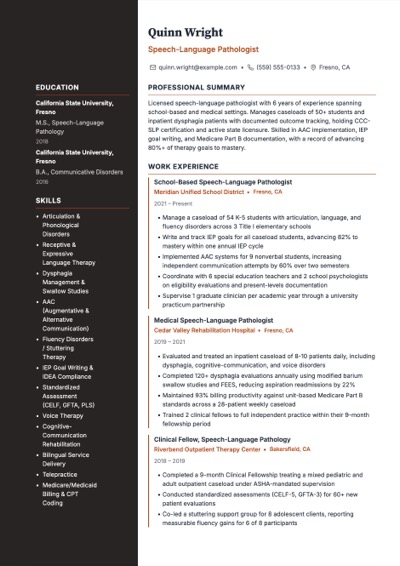
Full Speech-Language Pathologist Resume Example
This is a complete fictional sample. Study the structure and evidence patterns, then replace every name, employer, number, skill, and accomplishment with information that is true for you.
Professional Summary
Licensed speech-language pathologist with 6 years of experience spanning school-based and medical settings. Manages caseloads of 50+ students and inpatient dysphagia patients with documented outcome tracking, holding CCC-SLP certification and active state licensure. Skilled in AAC implementation, IEP goal writing, and Medicare Part B documentation, with a record of advancing 80%+ of therapy goals to mastery.
Work Experience
School-Based Speech-Language Pathologist
2021 – PresentMeridian Unified School District — Fresno, CA
- Manage a caseload of 54 K-5 students with articulation, language, and fluency disorders across 3 Title I elementary schools
- Write and track IEP goals for all caseload students, advancing 82% to mastery within one annual IEP cycle
- Implemented AAC systems for 9 nonverbal students, increasing independent communication attempts by 60% over two semesters
- Coordinate with 6 special education teachers and 2 school psychologists on eligibility evaluations and present-levels documentation
- Supervise 1 graduate clinician per academic year through a university practicum partnership
Medical Speech-Language Pathologist
2019 – 2021Cedar Valley Rehabilitation Hospital — Fresno, CA
- Evaluated and treated an inpatient caseload of 8-10 patients daily, including dysphagia, cognitive-communication, and voice disorders
- Completed 120+ dysphagia evaluations annually using modified barium swallow studies and FEES, reducing aspiration readmissions by 22%
- Maintained 93% billing productivity against unit-based Medicare Part B standards across a 28-patient weekly caseload
- Trained 2 clinical fellows to full independent practice within their 9-month fellowship period
Clinical Fellow, Speech-Language Pathology
2018 – 2019Riverbend Outpatient Therapy Center — Bakersfield, CA
- Completed a 9-month Clinical Fellowship treating a mixed pediatric and adult outpatient caseload under ASHA-mandated supervision
- Conducted standardized assessments (CELF-5, GFTA-3) for 60+ new patient evaluations
- Co-led a stuttering support group for 8 adolescent clients, reporting measurable fluency gains for 6 of 8 participants
Education
- M.S., Speech-Language Pathology — California State University, Fresno · 2018
- B.A., Communicative Disorders — California State University, Fresno · 2016
Certifications
- ASHA Certificate of Clinical Competence (CCC-SLP)
- Licensed Speech-Language Pathologist — California (active)
- VitalStim Therapy Certified
- PROMPT Trained (Level 1)
Achievement bullet patterns
Adapt the sentence pattern to your work. Never copy an employer, number, tool, or outcome that is not true for you.
- 1
Managed a caseload of 54 K-5 students across 3 Title I elementary schools, advancing 82% of articulation goals to mastery within one IEP cycle
Adapt the pattern; do not copy facts that are not yours.
- 2
Completed 120+ dysphagia evaluations annually using MBSS and FEES, reducing aspiration pneumonia readmissions by 22% through diet-compliance tracking
Adapt the pattern; do not copy facts that are not yours.
- 3
Implemented AAC systems for 9 nonverbal students, increasing independent functional communication attempts by 60% over two semesters
Adapt the pattern; do not copy facts that are not yours.
- 4
Maintained 93% billing productivity across a 28-patient weekly outpatient caseload while training 2 clinical fellows to full independence
Adapt the pattern; do not copy facts that are not yours.
Practical writing guidance
- 1
State your caseload size by setting: "Managed a caseload of 52 K-5 students across 3 elementary schools" proves capacity in a single line
- 2
Report IEP goal mastery rates or discharge outcome percentages rather than just listing therapy types you provide
- 3
Name your dysphagia evaluation tools explicitly (MBSS, FEES, VitalStim) if you work in a medical setting, since these are common keyword searches
- 4
Include billing productivity percentages for medical and clinic roles, such as maintaining 90%+ productivity against a unit-based standard
- 5
List your CCC-SLP, state license, and Clinical Fellowship completion date (if applicable) in a dedicated credentials section
- 6
Tailor your skills section to the setting: IDEA and present-levels writing for schools, physician collaboration and CPT coding for medical roles
How to write a speech-language pathologist resume
Open with caseload size and setting, not a mission statement
Translate therapy sessions into measurable clinical outcomes
Separate credentials, IDEA/Medicare compliance, and CE clearly
Build a speech-language pathologist resume in Guul
Keyword screening often happens before a person reads your resume. These are the terms and credentials worth backing with real experience, not stuffing in.
Skills hiring software likely screens for
Keyword filters often match terms literally. Use the posting’s exact wording.
- Speech Sound Disorders (Articulation & Phonology)
- Expressive & Receptive Language Intervention
- Dysphagia Evaluation & Treatment
- Modified Barium Swallow Study (MBSS)
- Fiberoptic Endoscopic Evaluation of Swallowing (FEES)
- Augmentative & Alternative Communication (AAC)
- Fluency Disorders
- Cognitive-Communication Therapy
- IEP Development & IDEA Compliance
- Standardized Assessment (CELF-5, GFTA-3, PLS-5)
- Telepractice
Certifications worth naming
List each one with its issuing body.
- Certificate of Clinical Competence in Speech-Language Pathology (CCC-SLP), ASHA
- State Speech-Language Pathology License (state licensing board)
- State Education Agency SLP Credential (school roles, where required)
- Board Certified Specialist in Swallowing and Swallowing Disorders (BCS-S)
- LSVT LOUD Certification (LSVT Global)
- VitalStim Therapy Certification
Software and tools to name
Name only the tools you have actually used.
- Epic
- PointClickCare
- WebPT
- Frontline IEP
- Proloquo2Go
- TouchChat
- Zoom
How Guul builds it
SLP resumes tend to lose screening matches in three places. Credentials get compressed into a line after the name, like “MS, CCC-SLP,” which a reader understands but which leaves a screen looking for a state license with nothing to find. Clinical skills get written as one long paragraph, so terms like dysphagia, AAC, or MBSS are hard for a parser to pick out. And clinicians who work across schools, home health, or contract agencies often list overlapping part-time roles without clear dates. Start with a summary that names your setting and population, for example school-age language and articulation or adult acute care. Then add a Licenses & Certifications section with each credential on its own line: CCC-SLP, state license, a school credential if your state requires one, and any specialty training you completed. Writing the full credential name next to the acronym helps either form match. Healthcare & Clinical puts that section near the top, while Chronological Classic and Minimalist ATS suit school district portals. When you paste a posting, tailoring compares its setting terms with your record and suggests wording for real matches only.
Templates that fit this role
What the ATS checker looks at for speech-language pathologist resumes
- CCC-SLP and state license each on their own line in the body, not only after your name
- Setting terms from the posting, such as IEP, dysphagia, MBSS, or AAC, matched against your experience
- Caseload size and outcomes, such as goals met or diet level changes, instead of duty lists
- Clear dates for overlapping contract, PRN, and school-year roles
- Assessment names written in full, such as CELF-5, so they read as keywords rather than stray letters
Frequently Asked Questions
How big should my caseload numbers be on an SLP resume?
List your actual caseload for each setting, such as "managed 55 students across 3 elementary schools" or "carried a daily caseload of 8-10 inpatient dysphagia patients." Specific numbers let hiring managers compare you directly against their current staffing gaps.
Do I need to list my CCC-SLP and state license separately?
Yes. List your ASHA Certificate of Clinical Competence and your state license as separate line items, since credentialing reviewers and ATS software scan for both terms independently. Include your Clinical Fellowship completion date if you are within your first year.
Should a school-based SLP resume look different from a medical one?
Yes. School resumes should emphasize IEP goal writing and IDEA compliance, while medical resumes should emphasize dysphagia tools like MBSS or FEES and billing productivity percentages. Tailor the summary and skills section to the setting you are applying to.
How do I show dysphagia experience if I mostly treat language disorders?
Quantify it honestly rather than omitting it: "Completed 40+ modified barium swallow study interpretations annually" or "Managed dysphagia cases for 15% of weekly sessions." A precise minority number is more credible than implying broad swallowing expertise.
How does Guul tailor a speech-language pathologist resume to a posting?
Paste the posting and Guul finds the setting language it uses, such as early intervention, school caseloads, swallow studies, or AAC devices. It checks those terms against what you entered and suggests wording where your experience fits. If the job asks for something you have not done, such as FEES, it shows that as a gap. It never adds a population, procedure, or credential for you.
I work in both schools and medical settings. Do I need two resumes?
Often, yes. The two settings screen for different words, and one resume that tries to cover both tends to run long. Build one full resume in Guul with all your experience, then make a school copy and a medical copy that lead with the right summary, skills, and bullets. Both copies come from the same real record, so nothing gets invented along the way.
How should a clinical fellow list credentials?
List your degree, your clinical fellowship with the setting and dates, and your state license status, which in some states is a provisional or temporary license during the fellowship. Do not list CCC-SLP until ASHA has awarded it. If your certification is pending, you can note the expected date.
Can Guul promise my resume will pass a hospital’s ATS?
No. Every hospital and district sets up its own system, so no tool can honestly promise a result. Guul’s checker simulates likely parsing across six named ATS families and explains each finding, which helps you fix common problems, such as a credential stuck in a header, before you apply.