
Turn inspiration into your own evidence
Do not copy the career. Learn how the career is communicated.
Read the evidence
Notice where the example uses scale, change, ownership, and context.
Replace every fact
Write from your real work, even when your numbers or setting are different.
Check the result
Make sure the document remains readable, truthful, and aligned to the role.
Key Skills
Use only the skills you can support with real experience. The example shows the vocabulary; your evidence makes it credible.
Full Biomedical Engineer Resume Example
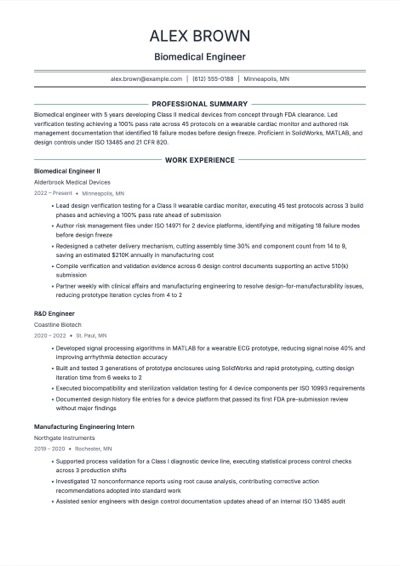
This is a complete fictional sample. Study the structure and evidence patterns, then replace every name, employer, number, skill, and accomplishment with information that is true for you.
Professional Summary
Biomedical engineer with 5 years developing Class II medical devices from concept through FDA clearance. Led verification testing achieving a 100% pass rate across 45 protocols on a wearable cardiac monitor and authored risk management documentation that identified 18 failure modes before design freeze. Proficient in SolidWorks, MATLAB, and design controls under ISO 13485 and 21 CFR 820.
Work Experience
Biomedical Engineer II
2022 – PresentAlderbrook Medical Devices — Minneapolis, MN
- Lead design verification testing for a Class II wearable cardiac monitor, executing 45 test protocols across 3 build phases and achieving a 100% pass rate ahead of submission
- Author risk management files under ISO 14971 for 2 device platforms, identifying and mitigating 18 failure modes before design freeze
- Redesigned a catheter delivery mechanism, cutting assembly time 30% and component count from 14 to 9, saving an estimated $210K annually in manufacturing cost
- Compile verification and validation evidence across 6 design control documents supporting an active 510(k) submission
- Partner weekly with clinical affairs and manufacturing engineering to resolve design-for-manufacturability issues, reducing prototype iteration cycles from 4 to 2
R&D Engineer
2020 – 2022Coastline Biotech — St. Paul, MN
- Developed signal processing algorithms in MATLAB for a wearable ECG prototype, reducing signal noise 40% and improving arrhythmia detection accuracy
- Built and tested 3 generations of prototype enclosures using SolidWorks and rapid prototyping, cutting design iteration time from 6 weeks to 2
- Executed biocompatibility and sterilization validation testing for 4 device components per ISO 10993 requirements
- Documented design history file entries for a device platform that passed its first FDA pre-submission review without major findings
Manufacturing Engineering Intern
2019 – 2020Northgate Instruments — Rochester, MN
- Supported process validation for a Class I diagnostic device line, executing statistical process control checks across 3 production shifts
- Investigated 12 nonconformance reports using root cause analysis, contributing corrective action recommendations adopted into standard work
- Assisted senior engineers with design control documentation updates ahead of an internal ISO 13485 audit
Education
- BS, Biomedical Engineering — University of Minnesota · 2020
Certifications
- Engineer in Training (EIT) Certification
- Six Sigma Green Belt Certified
Achievement bullet patterns
Adapt the sentence pattern to your work. Never copy an employer, number, tool, or outcome that is not true for you.
- 1
Led design verification testing for a Class II wearable cardiac monitor, executing 45 test protocols across 3 build phases and achieving a 100% pass rate before submission
Adapt the pattern; do not copy facts that are not yours.
- 2
Authored risk management documentation under ISO 14971 for 2 device platforms, identifying and mitigating 18 failure modes prior to design freeze
Adapt the pattern; do not copy facts that are not yours.
- 3
Redesigned a catheter delivery mechanism that cut assembly time 30% and reduced component count from 14 to 9, saving an estimated $210K annually in manufacturing cost
Adapt the pattern; do not copy facts that are not yours.
- 4
Supported a 510(k) submission by compiling verification and validation evidence across 6 design control documents, contributing to clearance within the target timeline
Adapt the pattern; do not copy facts that are not yours.
Practical writing guidance
- 1
Quantify device or system performance: 'Reduced signal noise 40% in a wearable ECG prototype' beats a description of your role
- 2
Cite regulatory milestones you contributed to, such as a 510(k) clearance timeline or the number of design control documents you authored
- 3
Name the standards you've worked under (ISO 13485, ISO 14971, 21 CFR 820) since regulated employers screen for direct familiarity
- 4
Quantify testing scope: number of test protocols executed, sample sizes, or pass rates on verification testing
- 5
Highlight cross-functional collaboration with clinical, regulatory, and manufacturing teams, since device development rarely happens in an engineering silo
- 6
Include patents, publications, or conference presentations if you have them — they carry real weight in R&D-focused roles
How to write a biomedical engineer resume
Anchor your summary in regulatory fluency, not just engineering skill
Document verification and validation work the way an auditor would read it
Use your capstone or internship to fill regulatory experience gaps
Frequently Asked Questions
What makes a biomedical engineering resume different from a general engineering resume?
It needs to show regulatory fluency alongside technical skill. Employers in medical devices expect familiarity with design controls, risk management, and verification and validation testing under FDA and ISO frameworks. Even entry-level candidates should reference coursework or capstone projects that touched these processes.
Should I include my senior design or capstone project on a biomedical engineering resume?
Yes, especially for entry-level candidates. Describe the project like professional experience: the clinical problem addressed, your specific technical contribution, testing performed, and any results or awards. A well-documented capstone can substitute for missing industry experience if you quantify the work involved.
How important are regulatory standards like ISO 13485 on a resume?
Very important for device industry roles. Naming specific standards you've worked under — ISO 13485, ISO 14971, 21 CFR 820 — helps you clear keyword screens and signals you understand the compliance environment. If you haven't worked under these standards directly, mention any regulatory coursework instead.
What certifications benefit a biomedical engineer?
A Fundamentals of Engineering (FE) exam pass and eventual Professional Engineer (PE) license carry weight for engineers pursuing licensure. Certified Quality Engineer (ASQ) credentials strengthen candidates targeting quality or regulatory-adjacent roles, differentiating them in competitive device R&D searches.