
Turn inspiration into your own evidence
Do not copy the career. Learn how the career is communicated.
Read the evidence
Notice where the example uses scale, change, ownership, and context.
Replace every fact
Write from your real work, even when your numbers or setting are different.
Check the result
Make sure the document remains readable, truthful, and aligned to the role.
Key Skills
Use only the skills you can support with real experience. The example shows the vocabulary; your evidence makes it credible.
Full Research Scientist Resume Example
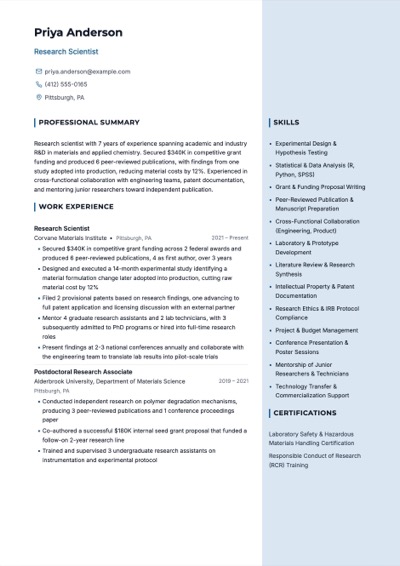
This is a complete fictional sample. Study the structure and evidence patterns, then replace every name, employer, number, skill, and accomplishment with information that is true for you.
Professional Summary
Research scientist with 7 years of experience spanning academic and industry R&D in materials and applied chemistry. Secured $340K in competitive grant funding and produced 6 peer-reviewed publications, with findings from one study adopted into production, reducing material costs by 12%. Experienced in cross-functional collaboration with engineering teams, patent documentation, and mentoring junior researchers toward independent publication.
Work Experience
Research Scientist
2021 – PresentCorvane Materials Institute — Pittsburgh, PA
- Secured $340K in competitive grant funding across 2 federal awards and produced 6 peer-reviewed publications, 4 as first author, over 3 years
- Designed and executed a 14-month experimental study identifying a material formulation change later adopted into production, cutting raw material cost by 12%
- Filed 2 provisional patents based on research findings, one advancing to full patent application and licensing discussion with an external partner
- Mentor 4 graduate research assistants and 2 lab technicians, with 3 subsequently admitted to PhD programs or hired into full-time research roles
- Present findings at 2-3 national conferences annually and collaborate with the engineering team to translate lab results into pilot-scale trials
Postdoctoral Research Associate
2019 – 2021Alderbrook University, Department of Materials Science — Pittsburgh, PA
- Conducted independent research on polymer degradation mechanisms, producing 3 peer-reviewed publications and 1 conference proceedings paper
- Co-authored a successful $180K internal seed grant proposal that funded a follow-on 2-year research line
- Trained and supervised 3 undergraduate research assistants on instrumentation and experimental protocol
Graduate Research Assistant
2015 – 2019Alderbrook University, Department of Chemistry — Pittsburgh, PA
- Completed dissertation research on catalytic reaction efficiency, resulting in 4 peer-reviewed publications during the doctoral program
- Presented research at 5 national and regional conferences, including one best-poster award
- Managed lab instrumentation scheduling and safety compliance for a 12-member research group
Education
- PhD, Chemistry — Alderbrook University · 2019
- BS, Chemistry — Penn State University · 2013
Certifications
- Laboratory Safety & Hazardous Materials Handling Certification
- Responsible Conduct of Research (RCR) Training
Achievement bullet patterns
Adapt the sentence pattern to your work. Never copy an employer, number, tool, or outcome that is not true for you.
- 1
Secured $340K in competitive grant funding across 2 federal awards and produced 6 peer-reviewed publications, 4 as first author, over a 3-year research appointment
Adapt the pattern; do not copy facts that are not yours.
- 2
Designed and executed a 14-month experimental study that identified a material formulation change later adopted into production, reducing raw material cost by 12%
Adapt the pattern; do not copy facts that are not yours.
- 3
Filed 2 provisional patents based on research findings, one of which advanced to full patent application and licensing discussion with an external partner
Adapt the pattern; do not copy facts that are not yours.
- 4
Mentored 4 graduate research assistants and 2 lab technicians, with 3 subsequently admitted to PhD programs or hired into full-time research roles
Adapt the pattern; do not copy facts that are not yours.
Practical writing guidance
- 1
Lead with funding and output, not job duties: 'Secured $340K in grant funding and produced 6 peer-reviewed publications over 3 years' establishes credibility in one line
- 2
Quantify your role in team research explicitly, such as first-author versus contributing-author publications, since committees weigh independent research leadership differently than support work
- 3
Translate lab results into applied impact when writing for industry R&D roles: 'Findings informed a product formulation change that reduced material cost by 12%' bridges research and business value
- 4
List patents filed or granted separately from publications, since intellectual property output signals commercialization potential that pure academic output does not
- 5
Name your statistical and technical tools specifically (R, Python, specific instrumentation) rather than writing 'data analysis,' since ATS systems and hiring managers search for named competencies
- 6
Include grant-writing and funding-securing experience even at a supporting-author level, since the ability to help win funding is a distinct, highly valued skill separate from bench research itself
How to write a research scientist resume
Open with funding secured and publication or patent output
Translate lab findings into applied impact for industry-facing roles
Separate independent research leadership from supporting contributions
Frequently Asked Questions
Should a research scientist resume look different for academic versus industry roles?
Yes, in emphasis. Academic and government lab postings weight publication count and grant history heavily. Industry R&D roles want the same rigor but expect findings translated into product or cost impact. Keep the experience section similar and adjust which outcomes you lead with.
How do I list publications on a resume versus a CV?
A resume should summarize publication output with a count and first-author ratio, such as '6 peer-reviewed publications, 4 as first author,' rather than a full bibliography. Save the complete list for an attached CV or portfolio link; a resume's job is to signal scope, not list every citation.
Is grant-writing experience valuable if I was only a supporting author on proposals?
Yes. Note your role accurately, such as 'contributed methodology and budget sections to a successful $340K proposal,' rather than implying sole authorship. Supporting-author grant experience signals you understand funding mechanics, which postings often screen for beyond bench skills.
How do I show impact if my research hasn't led to a product or publication yet?
Report process-level outcomes instead: experiments completed on schedule, methodology improvements that reduced cost, or preliminary findings presented at a conference. Reviewers understand not all research reaches publication within a resume's timeframe, but still expect evidence of rigor.