
Turn inspiration into your own evidence
Do not copy the career. Learn how the career is communicated.
Read the evidence
Notice where the example uses scale, change, ownership, and context.
Replace every fact
Write from your real work, even when your numbers or setting are different.
Check the result
Make sure the document remains readable, truthful, and aligned to the role.
Key Skills
Use only the skills you can support with real experience. The example shows the vocabulary; your evidence makes it credible.
Full Epidemiologist Resume Example
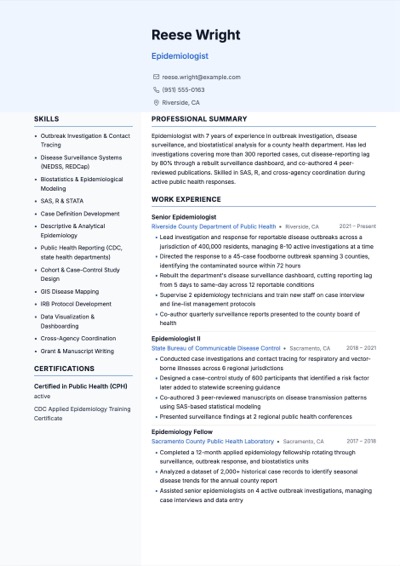
This is a complete fictional sample. Study the structure and evidence patterns, then replace every name, employer, number, skill, and accomplishment with information that is true for you.
Professional Summary
Epidemiologist with 7 years of experience in outbreak investigation, disease surveillance, and biostatistical analysis for a county health department. Has led investigations covering more than 300 reported cases, cut disease-reporting lag by 80% through a rebuilt surveillance dashboard, and co-authored 4 peer-reviewed publications. Skilled in SAS, R, and cross-agency coordination during active public health responses.
Work Experience
Senior Epidemiologist
2021 – PresentRiverside County Department of Public Health — Riverside, CA
- Lead investigation and response for reportable disease outbreaks across a jurisdiction of 400,000 residents, managing 8-10 active investigations at a time
- Directed the response to a 45-case foodborne outbreak spanning 3 counties, identifying the contaminated source within 72 hours
- Rebuilt the department's disease surveillance dashboard, cutting reporting lag from 5 days to same-day across 12 reportable conditions
- Supervise 2 epidemiology technicians and train new staff on case interview and line-list management protocols
- Co-author quarterly surveillance reports presented to the county board of health
Epidemiologist II
2018 – 2021State Bureau of Communicable Disease Control — Sacramento, CA
- Conducted case investigations and contact tracing for respiratory and vector-borne illnesses across 6 regional jurisdictions
- Designed a case-control study of 600 participants that identified a risk factor later added to statewide screening guidance
- Co-authored 3 peer-reviewed manuscripts on disease transmission patterns using SAS-based statistical modeling
- Presented surveillance findings at 2 regional public health conferences
Epidemiology Fellow
2017 – 2018Sacramento County Public Health Laboratory — Sacramento, CA
- Completed a 12-month applied epidemiology fellowship rotating through surveillance, outbreak response, and biostatistics units
- Analyzed a dataset of 2,000+ historical case records to identify seasonal disease trends for the annual county report
- Assisted senior epidemiologists on 4 active outbreak investigations, managing case interviews and data entry
Education
- Master of Public Health (MPH), Epidemiology — University of California, Berkeley · 2017
- BS, Biology — University of California, Davis · 2015
Certifications
- Certified in Public Health (CPH) — active
- CDC Applied Epidemiology Training Certificate
Achievement bullet patterns
Adapt the sentence pattern to your work. Never copy an employer, number, tool, or outcome that is not true for you.
- 1
Directed the investigation of a 45-case foodborne outbreak across 3 counties, identifying the contaminated source within 72 hours and halting further transmission
Adapt the pattern; do not copy facts that are not yours.
- 2
Built and maintained a surveillance dashboard tracking 12 reportable diseases across a jurisdiction of 400,000 residents, cutting reporting lag from 5 days to same-day
Adapt the pattern; do not copy facts that are not yours.
- 3
Co-authored 4 peer-reviewed manuscripts on respiratory disease transmission patterns, cited in 2 state-level public health policy updates
Adapt the pattern; do not copy facts that are not yours.
- 4
Designed a case-control study of 600 participants that identified a risk factor later incorporated into statewide screening guidelines
Adapt the pattern; do not copy facts that are not yours.
Practical writing guidance
- 1
Quantify outbreak response: 'Led investigation of a 45-case salmonella outbreak, identifying the source within 72 hours' shows speed and impact
- 2
Name the surveillance systems and statistical software you used (SAS, R, NEDSS) since these are exact-match ATS keywords for public health postings
- 3
Report the scale of the population or dataset you analyzed, such as case counts, cohort sizes, or the jurisdiction population covered
- 4
Show downstream impact, such as a policy adopted, a reporting protocol changed, or an intervention that measurably reduced case counts
- 5
Include peer-reviewed publications or conference presentations if applicable, since research output is a strong differentiator for senior roles
- 6
Highlight cross-agency or interdisciplinary coordination, since real outbreak response depends on working with labs, clinicians, and other jurisdictions
How to write an epidemiologist resume
Lead with the scale of surveillance and investigation you have owned
Turn investigations and analyses into outcomes, not task lists
Document your tools, publications, and cross-agency coordination clearly
Frequently Asked Questions
What should a recent MPH graduate include on an epidemiologist resume?
Highlight practicum or fieldwork placements, thesis or capstone research, and any statistical software you used, such as SAS or R. List specific datasets you analyzed, sample sizes, and findings that informed a report. Include relevant biostatistics coursework if you lack full-time experience.
How do I show outbreak investigation experience if I only assisted rather than led?
Describe your specific role clearly, such as conducting case interviews, managing a line list, or running statistical analysis for a lead investigator. Quantify what you handled, like the number of cases interviewed. Being precise reads as more credible than overstating leadership you did not have.
Should I list every statistical software program I have used?
List the programs you can use independently, typically 2 to 4 tools such as SAS, R, STATA, or Epi Info. Job postings often specify a required platform, so match your listed skills to what the employer names. Avoid padding the list with tools you only touched in a single course.
How long should an epidemiologist resume be?
One page works for early-career epidemiologists with limited publication history. Two pages fit once you have several years of surveillance experience, multiple publications, or grant involvement to document. Prioritize outbreak response and analytical impact over listing every task performed.