
Turn inspiration into your own evidence
Do not copy the career. Learn how the career is communicated.
Read the evidence
Notice where the example uses scale, change, ownership, and context.
Replace every fact
Write from your real work, even when your numbers or setting are different.
Check the result
Make sure the document remains readable, truthful, and aligned to the role.
Key Skills
Use only the skills you can support with real experience. The example shows the vocabulary; your evidence makes it credible.
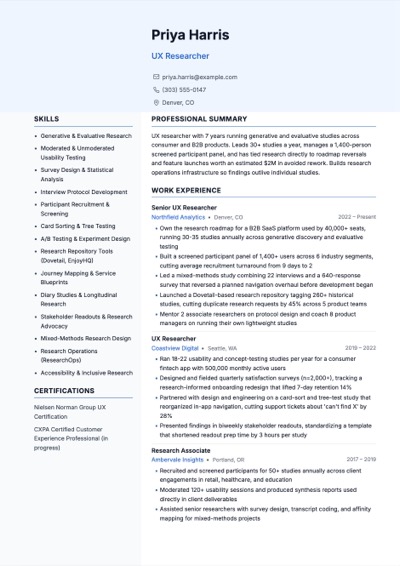
Full UX Researcher Resume Example
This is a complete fictional sample. Study the structure and evidence patterns, then replace every name, employer, number, skill, and accomplishment with information that is true for you.
Professional Summary
UX researcher with 7 years running generative and evaluative studies across consumer and B2B products. Leads 30+ studies a year, manages a 1,400-person screened participant panel, and has tied research directly to roadmap reversals and feature launches worth an estimated $2M in avoided rework. Builds research operations infrastructure so findings outlive individual studies.
Work Experience
Senior UX Researcher
2022 – PresentNorthfield Analytics — Denver, CO
- Own the research roadmap for a B2B SaaS platform used by 40,000+ seats, running 30-35 studies annually across generative discovery and evaluative testing
- Built a screened participant panel of 1,400+ users across 6 industry segments, cutting average recruitment turnaround from 9 days to 2
- Led a mixed-methods study combining 22 interviews and a 640-response survey that reversed a planned navigation overhaul before development began
- Launched a Dovetail-based research repository tagging 260+ historical studies, cutting duplicate research requests by 45% across 5 product teams
- Mentor 2 associate researchers on protocol design and coach 8 product managers on running their own lightweight studies
UX Researcher
2019 – 2022Coastview Digital — Seattle, WA
- Ran 18-22 usability and concept-testing studies per year for a consumer fintech app with 500,000 monthly active users
- Designed and fielded quarterly satisfaction surveys (n=2,000+), tracking a research-informed onboarding redesign that lifted 7-day retention 14%
- Partnered with design and engineering on a card-sort and tree-test study that reorganized in-app navigation, cutting support tickets about 'can't find X' by 28%
- Presented findings in biweekly stakeholder readouts, standardizing a template that shortened readout prep time by 3 hours per study
Research Associate
2017 – 2019Ambervale Insights — Portland, OR
- Recruited and screened participants for 50+ studies annually across client engagements in retail, healthcare, and education
- Moderated 120+ usability sessions and produced synthesis reports used directly in client deliverables
- Assisted senior researchers with survey design, transcript coding, and affinity mapping for mixed-methods projects
Education
- MS, Human-Computer Interaction — University of Washington · 2017
- BA, Psychology — University of Colorado Boulder · 2015
Certifications
- Nielsen Norman Group UX Certification
- CXPA Certified Customer Experience Professional (in progress)
Achievement bullet patterns
Adapt the sentence pattern to your work. Never copy an employer, number, tool, or outcome that is not true for you.
- 1
Ran 34 moderated usability studies and 9 unmoderated benchmark tests across 3 product lines in one year, briefing 60+ stakeholders on findings each quarter
Adapt the pattern; do not copy facts that are not yours.
- 2
Built and managed a screened participant panel of 1,400+ users spanning 6 customer segments, cutting average recruitment time from 9 days to 2
Adapt the pattern; do not copy facts that are not yours.
- 3
Led a mixed-methods study (22 interviews, 640-response survey) that reversed a planned navigation redesign, avoiding an estimated $200K in rework
Adapt the pattern; do not copy facts that are not yours.
- 4
Launched a shared research repository tagging 260+ past studies, reducing duplicate research requests by 45% and cutting new-study kickoff time in half
Adapt the pattern; do not copy facts that are not yours.
Practical writing guidance
- 1
State your research throughput directly: 'Ran 38 studies across 4 product lines in FY25' tells a hiring manager your operating scale in one line
- 2
Chase every finding with what changed because of it — a shipped feature, a canceled roadmap item, a redesigned flow — not just what you discovered
- 3
Name your recruitment pipeline: panel size, screener pass rate, or how you cut time-to-first-session, since recruiting is often the actual bottleneck
- 4
Pair qualitative findings with sample sizes and, where relevant, statistical confidence — '14 participants' reads differently than '14 participants, saturation reached by session 11'
- 5
List research operations work separately from individual studies: repositories built, intake processes launched, or research democratized to non-researchers
- 6
Quantify cycle time — how many days from research kickoff to a decision-ready readout — since speed is a recurring hiring criterion at fast-moving companies
How to write a UX researcher resume
Lead with research scope and reach, not job duties
Tie every study to a decision it changed
Separate research operations work from individual studies for ATS clarity
Frequently Asked Questions
How is a UX researcher resume different from a UX designer resume?
A UX designer resume leans on a portfolio of visual and interaction work; a UX researcher resume leans on study design, sample rigor, and decisions your findings changed. Lead with methods and participant reach rather than screenshots, and cite the roadmap or interface outcome each study produced.
Do I need a statistics background to list quantitative research skills?
No advanced degree is required, but you should speak to sample sizes and confidence for surveys or A/B tests, and know when a qualitative sample is sufficient. List the specific quantitative methods you've run — benchmarks, tree tests, surveys — rather than a vague 'quant skills' bullet.
How do I quantify research impact if I don't control the roadmap?
Track adoption, not authority: cite the specific decision, feature, or canceled initiative tied to your study, even if a product manager made the final call. 'Findings informed the decision to delay X' is a legitimate, honest impact claim that hiring panels recognize as normal for the role.
Should I list research tools like Dovetail or UserTesting by name?
Yes, but group them under a labeled category rather than scattering them through your bullets. Recruiters and ATS keyword scans both respond to named tools, and naming your repository platform signals you can operationalize research at scale, not just run individual studies.